Understand the three chords
In C major, C is I, F is IV and G is V. The Roman numerals tell you where each chord comes from in the key. You can hear the same relationship in other keys, even when the chord names change.
For this exercise, give each chord four beats: one bar of C, one bar of F and one bar of G, then return to C. This is a simple practice loop rather than the exact form of a particular song.
Count each bar: 1 · 2 · 3 · 4
After G, return to C and repeat.
Choose shapes you can play cleanly
Use chord shapes you already know. An open C shape is x–3–2–0–1–0, and one open G shape is 3–2–0–0–0–3, reading from low E to high E. For F, try the smaller four-string shape x–x–3–2–1–1. Your first finger holds the B and high E strings at fret 1; leave the low E and A strings out.
If that F shape is new, practise setting it down and releasing it before starting the loop. Play its strings separately to hear any muted notes. A clean, smaller voicing is a useful starting point.
Build a ten-minute session
- Two minutes: prepare the changes. Move C→F, F→G and G→C without a backing loop. Watch where each finger goes.
- Three minutes: keep time. Start around 50–60 beats per minute, or slower if needed. Count four beats aloud and strum only on beat 1 of each bar.
- Three minutes: add one job. If the changes are steady, strum on beats 1 and 3. If a change is late, return to one strum per bar.
- Two minutes: listen. Keep the same tempo and hear how the return to C feels after G. Finish with one comfortable pass through the loop.
Raise the tempo only after you can keep several repeats steady. If your hand tenses or the rhythm falls apart, lower the tempo and simplify. A loop is useful because you can adjust the task and hear the result again immediately.
Explore it in Fretweave
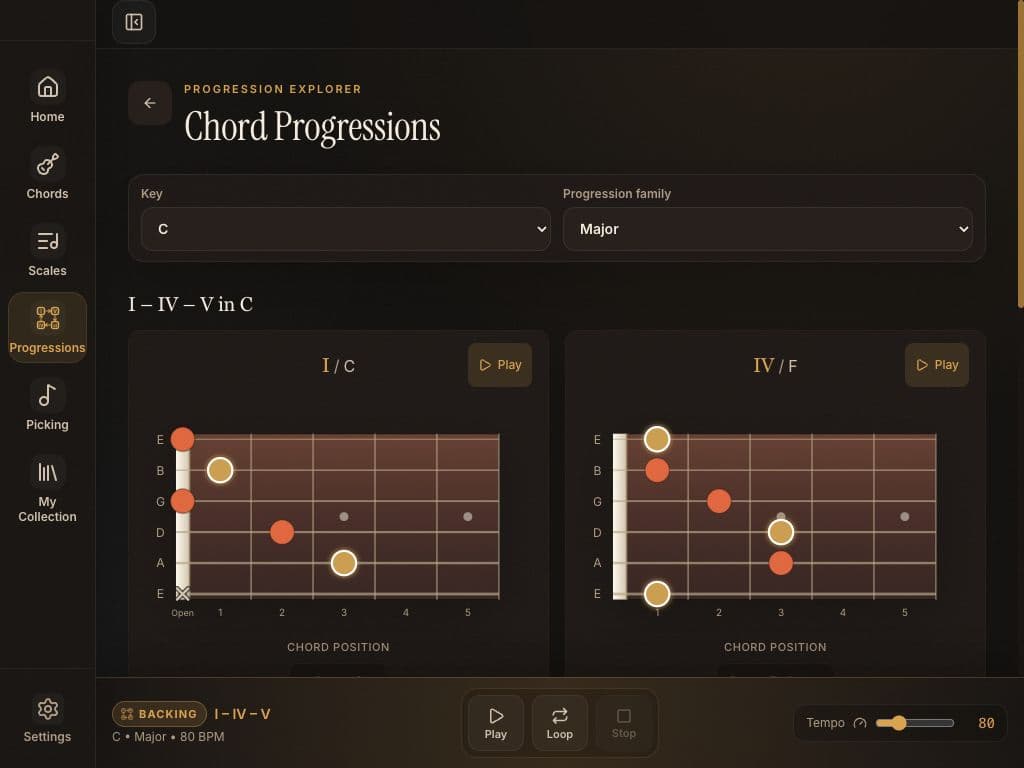
Choose the C I–IV–V progression and play its C–F–G changes. The free library includes three progression templates in every key, and those progressions already loop. Pro adds the wider progression library, voicing choices and advanced practice options.
Related song names are educational examples of similar chord changes; they are not full playable song lessons. For a melody exercise, connect the chord notes to a scale.
Fretweave is coming soon to iPad.
See the app in action