Set up an open C chord
In standard tuning, hold C major: x–3–2–0–1–0, reading from low E to high E. Leave the low E string out. Check that the A, G, B and high E strings sound clearly, one at a time.
Rest your picking hand comfortably above the strings. Use the thumb for the A string, index for G, middle for B and ring finger for high E. Keep the movements small and allow the notes to ring.
| Count | Finger | String / note |
|---|---|---|
| 1 | Thumb (p) | A · C at fret 3 |
| 2 | Index (i) | G · Open G |
| 3 | Middle (m) | B · C at fret 1 |
| 4 | Ring (a) | High E · Open E |
The letters p, i, m and a are common finger labels. For now, one note on each count is enough.
Put the pattern together
- First minute: play only the thumb note, then only the three finger notes. Listen for an even volume.
- Next two minutes: count 1–2–3–4 slowly and play thumb–index–middle–ring, one note per beat. Pause, then repeat.
- Final two minutes: repeat without a pause. Keep the same relaxed motion as you return from the ring finger to the thumb.
If a string buzzes, stop and check the fretting hand. Place the fingertip close behind the fret, and check that it does not lean into a neighbouring string. If the picking order becomes confusing, play just thumb–index until that feels clear, then add the other fingers.
Take one small step towards alternating bass
When the four-note pattern feels comfortable, try moving the thumb between the A and D strings while holding C. On this chord, those strings give you C at fret 3 and E at fret 2. Play thumb on A, index on G, thumb on D, middle on B, then repeat slowly.
This introduces the idea of an alternating bass under higher notes. It is a preparation exercise, not a complete description of every Travis picking pattern. Keep the bass steady before adding extra notes, pinches or a chord change.
Once one chord feels settled, practise a slow chord progression while keeping the picking movement as simple as possible.
Explore it in Fretweave
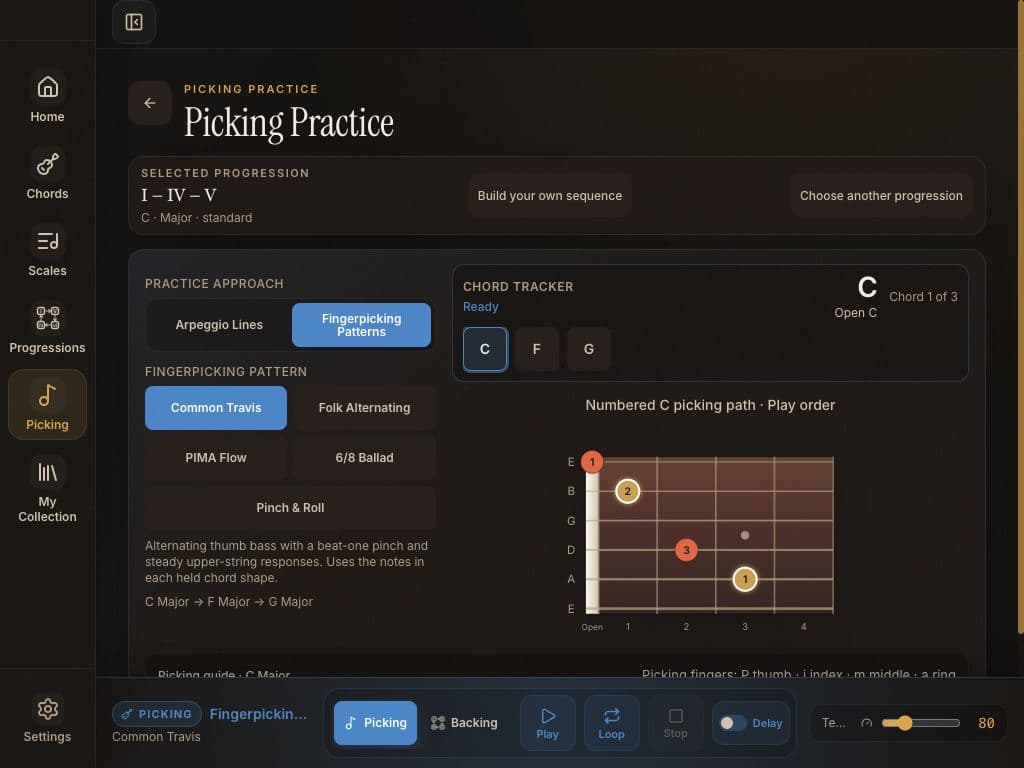
Picking Practice shows a pattern and gives you tempo controls for repeating it. The free core includes the Straight arpeggio and Common Travis starter patterns. The screenshot shows Common Travis; the four-note exercise above is a separate preparation exercise. Pro adds more arpeggio and fingerpicking choices.
Fretweave is coming soon to iPad.
See the app in action